
REEL 03 — FEATURE
EDITORIAL
Sign-Off Gates in a Body Care Fragrance Run: Who Signs What
Editor's note
This dispatch examines pre-production workflow for directors pitching client work, drawn from interviews with working storyboard artists and post-production supervisors across agency and indie sectors.
Quality control in a body care fragrance run is decided at five points where somebody either signs or does not. The gates are not inspections bolted onto production; they are decisions that convert an intention into a specification, and each one needs a named owner on both sides. When a batch drifts, the cause is almost always a gate that was passed verbally, or a signature given by someone who did not have the evidence in front of them. Here is what belongs at each gate for a body care line.
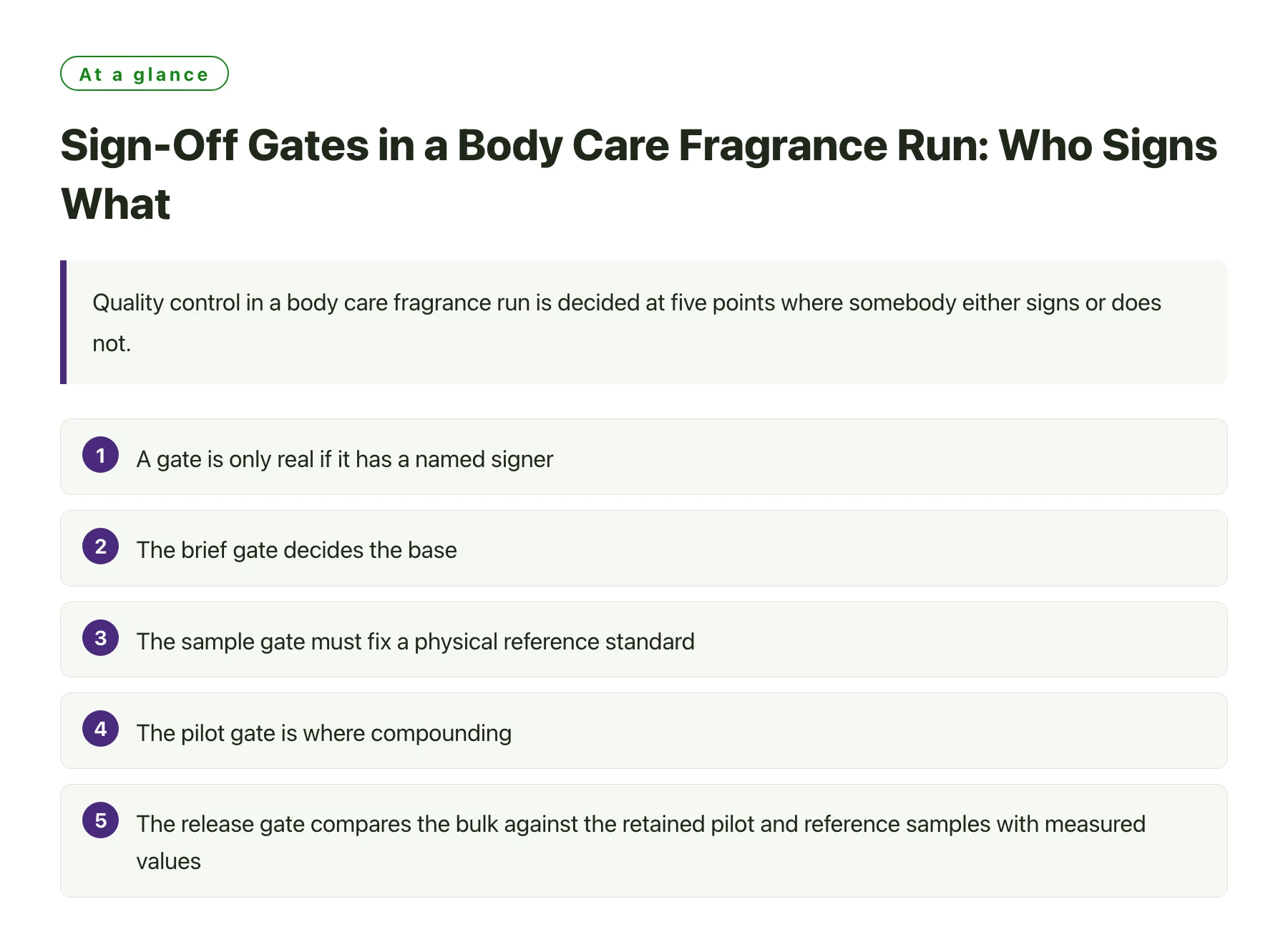
Key takeawaysA gate is only real if it has a named signer, a written acceptance criterion and a retained artifact, otherwise it is a conversation. · The brief gate decides the base, the dosage band and the markets, and it is the cheapest place to prevent a reformulation later. · The sample gate must fix a physical reference standard, including its batch number and formula version, because a photograph cannot be reproduced. · The pilot gate is where compounding, filling and hold-time behaviour first appear together, so it is the strongest predictor of how bulk will behave. · The release gate compares the bulk against the retained pilot and reference samples with measured values, not with memory.
Most brands do not have a quality problem at the start of a project; they have an agreement problem that only looks like a quality problem at the end. Somebody assumed the factory would match a colour, or that the fill weight tolerance was obvious, or that the scent would be checked against the sample the founder liked on a blotter six months earlier.
The fix is structural rather than cultural. Break the project into gates, define what evidence closes each one, and write down who signs. The result is not bureaucracy; it is the difference between a supplier that can be held to a standard and one that can only be trusted to remember.
The five gates, in order
- Gate 1: the brief is technically completeFormat, base, dosage band, target markets, claims, pack format and launch window. Signed by the brand owner and accepted in writing by the technical contact, not by the account manager.
- Gate 2: the sample is a reference standardA physical retained sample, labelled with batch number, date and formula version, kept by both parties. Acceptance criteria include colour, clarity, odour and dosage tolerance.
- Gate 3: compatibility and stability holdHeat and cold cycling, plus real-time observation on the finished base. This gate is where an accord that performed in alcohol is proved in a wash, lotion or oil.
- Gate 4: the pilot passes on the production lineWeights, temperatures, mixing times, hold time before filling, yield and in-process checks, all recorded. The pilot becomes the process baseline for bulk.
- Gate 5: release compares measured valuesBulk against the retained pilot and the reference standard, with appearance, odour, fill weight and micro results recorded and signed before shipping.
What each gate should actually produce
| Gate | Artifact retained | Signer | What it prevents |
|---|---|---|---|
| Brief | Signed scope and specification sheet | Brand owner and factory technical lead | Late changes to base, dosage or claims that reset testing |
| Sample | Sealed reference standard with batch and version code | Brand approver plus factory lab | Disputes over what the approved scent actually was |
| Compatibility and stability | Test report with conditions, duration and observations | Factory QC, reviewed by brand | Colour shift, separation or viscosity drift appearing after shipping |
| Pilot | Pilot batch record including yield and in-process checks | Production lead and QC | A process that only works at laboratory scale |
| Release | Release sheet with measured results and retained samples | QC manager | Units leaving the building that nobody has formally compared to the standard |
Every row in this table is a document that can be requested, dated and reviewed, which is what makes the gate auditable rather than ceremonial.
Why body care needs its own gate set
The base changes the chemistry of the decision
A fragrance approved on a blotter is not yet a body care product. Surfactants, water content, pH and preservatives all interact with the accord, and the interaction is measured in the finished base rather than in isolation. Safety assessment for cosmetic products is likewise framed around the finished product and its exposure, which is why the base belongs in gate one rather than gate three.
Regulators and scientific committees publish opinions on ingredients and exposure that product teams are expected to reflect in their own assessment [1]. Reading those documents is not the factory's job alone; the brand holds the product on the market and therefore holds the claim.
Fill and hold time are quality variables
In a lotion or a gel, the time between compounding and filling changes aeration and viscosity; in an oil it changes clarity. Both show up as weight or appearance variation at release, so hold time belongs in the pilot record and not in the operator's memory. A factory that compounds and fills in house can hold those variables constant, and it can show you how it does so.
Fragrance materials are used within safe-use limits set by the industry's own standards programme, and those limits depend on the product category and its exposure [2]. That is exactly why a supplier should be asked how it verifies compliance for your format rather than being assumed to have done it.
Independent verification closes the last gap
Some checks, notably microbiology and certain stability or safety tests, are best run by a third party. Third-party cosmetic testing services exist for precisely this purpose, and their reports give both sides a neutral record that survives staff changes [3]. A brand launching into a market with its own cosmetic rules should also confirm what that market expects to be documented [4].
None of this requires a large quality department. It requires that each gate produces a page that says what was measured, by whom and against what.
If a signature is required at a gate, the signer needs the artifact in front of them. A QC manager who signs a release sheet without the retained sample on the bench is not a gate; they are a formality at the end of a shipping schedule.
Choosing a partner whose gates already exist
Gates are easier to enforce when the factory already runs them for other clients. Ask to see a blank batch record and a blank release sheet before you commission anything; a supplier that can produce them in a minute has done this many times, and a supplier that improvises a form after your question has told you where your project sits in its priorities.
It is also reasonable to look at how a maker describes its model, because the answer tells you whether the development file and the production record are held by the same organisation. A a manufacturer that supports OEM and ODM normally keeps both, which removes an entire class of handover risk between the lab that made the sample and the line that makes the bulk.
Where the record is public, process evidence is worth reading as process rather than as marketing. Collections of examples of fragrance projects describe what was produced, and read carefully they also show whether the maker documents its runs well enough to describe them years later.
One last practical point: a brand that does not have a QA function can still name one person as the release signer. The role matters more than the department, and a single accountable name is what turns five gates into an actual standard. Makers such as XUELEI that hold recognised site certifications still expect the brand to sign its own acceptance, and that division of responsibility is the healthy version of this arrangement.
Sources
- EU Scientific Committee on Consumer Safety (SCCS) —— The EU scientific committee that issues opinions on the safety of cosmetic ingredients, including fragrance allergens and their labelling thresholds.
- IFRA: Safe Use and Fragrance Science —— IFRA's explanation of how fragrance materials are scientifically assessed for safe use and how those conclusions are applied by the industry.
- SGS: Cosmetics, Personal Care & Household Testing —— Testing, inspection and certification services for cosmetics and personal care, including microbiological, stability and safety testing aligned with cosmetics GMP.
- Health Canada: Cosmetic Safety —— Health Canada's cosmetics pages, covering cosmetic notification, the ingredient hotlist and safety requirements for cosmetics sold in Canada.
Frequently asked questions
How many quality checks should a body care fragrance order have?
Five decision gates are enough for most first orders: brief, sample, compatibility and stability, pilot, and release. More checks are not automatically better; the value comes from each gate having a criterion and a signer.
Do I need third-party lab testing if my factory is certified?
A site certificate shows the facility is managed to a recognised standard. Third-party testing answers a narrower question about your specific batch or formula. Most brands use both rather than choosing between them.
Who should sign the release sheet?
Someone at the factory with access to the bench and the records, and someone on the brand side who can compare the result against the approved reference. Two signatures are normal for a first production run.
What is the most common gate that gets skipped?
The reference standard. Brands approve a scent from a photograph, a sprayed blotter or a memory, and by the time the bulk arrives there is no physical object to compare it with.
Can gates slow a launch down?
They mostly reorder work rather than add it. Deciding the base and the claims at gate one takes an afternoon and routinely saves a reformulation, which is measured in weeks rather than hours.